High-Speed Rail Proposal Faces Scrutiny Amid Alternative Plan
📅 3 days ago
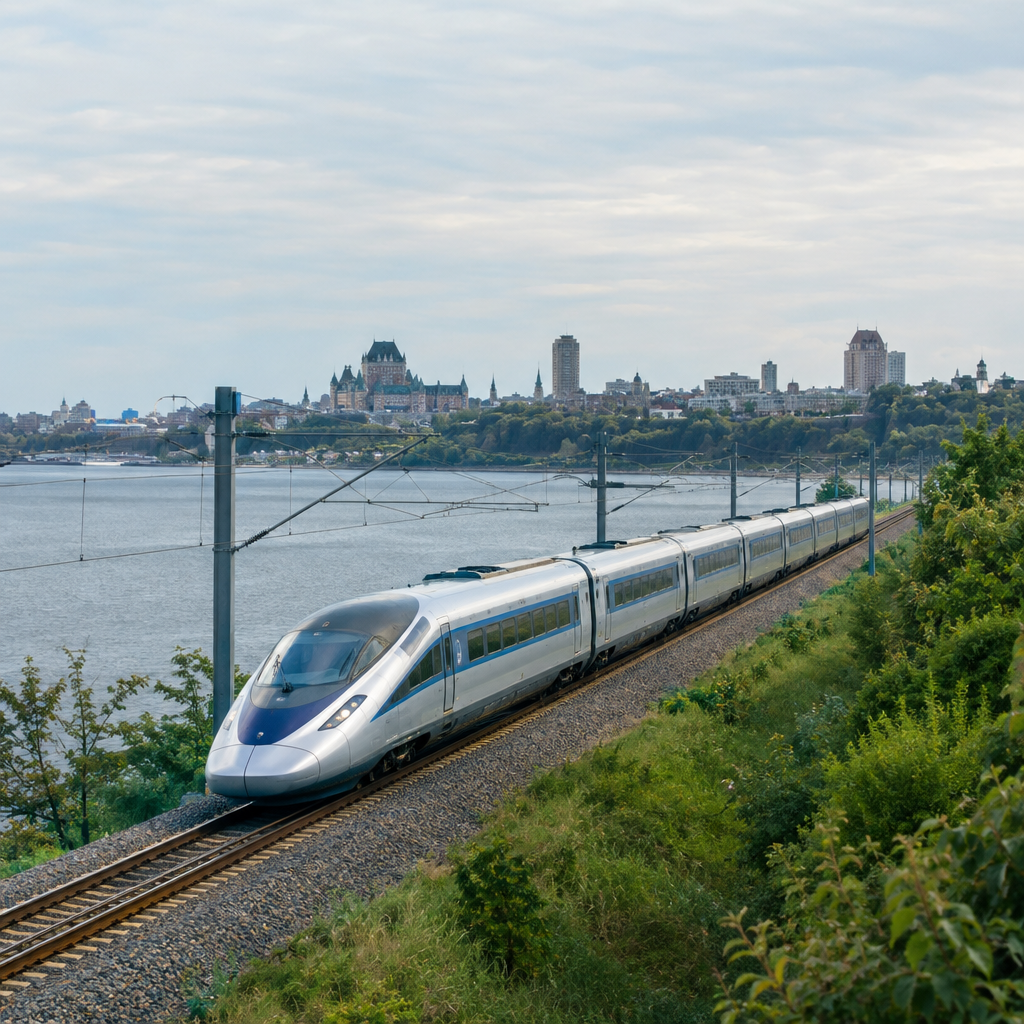
A new study proposing a cheaper alternative to the high-speed rail project between Quebec City and Toronto has sparked debate, with the original project proponents questioning its feasibility and impact on freight operations.
MONTREAL — The Crown corporation responsible for the proposed high-speed train connecting Quebec City and Toronto has raised concerns regarding a recent study that suggests a more economical and slower alternative. This study, released by Vision Transport in collaboration with the agricultural group Union des producteurs agricoles, proposes that cost savings could be achieved by modernizing the existing rail tracks. The research was conducted by Vincent Duguay, a master’s student at École nationale d’administration publique, alongside Pierre DuSablon, a rail industry expert with considerable experience.The study explores two potential scenarios: one that serves the same 22 stations currently accessible via Via Rail and another that operates as an express route with stops limited to major cities. According to the authors, the modernized route, which would include intermediate stations like Saint-Hyacinthe and Drummondville, could cut travel time to six hours and 40 minutes. Conversely, an express service would reduce travel time to five hours and 50 minutes. In contrast, Alto’s high-speed rail proposal aims to connect Quebec City to Toronto in just four hours and 30 minutes, significantly shorter than the current eight hours and 40 minutes required for rail travel, which is only marginally faster than car travel.
The study's authors emphasize that their proposed project would still offer a speed advantage over driving. Martin Caron, president of UPA, expressed concerns about the potential expropriation of farmland, stating, "Farmers don’t want to have their land expropriated only to find out, in the end, that it doesn’t happen because it’s going to cost too much. So, can we look at other alternatives that will have much less of an impact and be much less expensive?"
Alto has responded by stating that it cannot simply increase the number of passenger trains on tracks owned by other railway companies, including CN, CPKC, or CFQG, due to the priority given to freight trains on these lines. The company cautioned that any delays or interruptions to freight operations during construction or operation could have detrimental effects on the Canadian economy, affecting businesses' export capabilities and agricultural operations.
Alto maintains that its decision to pursue high-speed rail is based on comprehensive analysis, which indicates that only high-speed rail can adequately fulfill the mobility needs of the corridor connecting Toronto and Quebec City. They argue that the speeds offered by a high-frequency service would not be competitive enough to entice commuters to choose rail over driving or flying.
The new study outlines five major proposals for modernization. The most significant and expensive component involves doubling the existing tracks along the entire route, adding tracks over 407 kilometers. Currently, 37 percent of the corridor operates on a single track, necessitating that passenger trains frequently pull onto sidings to allow freight trains to pass.
The second proposal includes upgrading the signaling system to decrease the distance between trains, enabling maximum speeds to increase from 153 km/h to 177 km/h. The third suggestion involves enhancing the authority of the Canadian Transportation Agency to prioritize passenger trains over freight. Unlike the high-speed proposal, which would create fenced tracks and eliminate level crossings, Vision Transport's plan would maintain the existing 924 level crossings while requiring 533 of them to be equipped with full barriers. Additionally, they suggest replacing one-third of the level crossings with overpasses to further reduce travel time between Montreal and Toronto by eight minutes.
The fifth proposal suggests replacing current rolling stock with tilting trains and tracks designed with steeper banking on curves to facilitate higher speeds. Alto estimates that the high-speed rail project could cost between $60 billion and $90 billion, while the parliamentary budget officer estimates costs between $73 billion and $113 billion. Other independent sources suggest the project could reach $150 billion.
In comparison, the modernization project proposed by Vision Transport is estimated to cost between $9 billion and $9.4 billion. When including a 20 percent contingency reserve, the initial cost rises to approximately $11 billion, a fraction of Alto’s estimates. The alternative proposal could see costs increase by $8.2 billion if it includes the expense of eliminating one-third of the level crossings for community acceptance and corridor modernization, bringing the total to around $21 billion. Furthermore, the electrification of the proposed modernized train line would require an additional investment of $3 billion to $7 billion, bringing the total potential cost to about $30 billion.
Alto warns that the costs of a high-frequency rail project could exceed the figures cited in the study, estimating a range of $45 billion to $75 billion. Via Rail currently does not control all rights-of-way along its routes between Quebec City and Toronto. Caron noted that using existing tracks and doubling them in various locations would enhance accessibility and reduce costs significantly with less impact on communities.
Quebec Premier Paul St-Pierre Plamondon has also voiced opposition to the Alto high-speed rail project, having campaigned against it prior to the Parti Québécois forming a minority government. He has described the project as potentially financially disastrous, referring to estimates from the Bloc Québécois that predict total costs could reach $200 billion. The UPA and its members oppose a northern route that would necessitate expropriations of farmland, referencing the extensive land expropriations associated with the failed Mirabel airport project in the 1960s, which ultimately saw its terminal demolished in 2014.
🏷️
rail travel
rail modernization
freight vs passenger
expropriation
sustainability
cost analysis
public transport
transportation infrastructure
Quebec
high-speed rail
← Previous Post
Choice Properties REIT Acquires Prime Redevelopment Site in Burnaby for $39.7 Million3 days ago
Next Article →
Streamlining Concrete Mix Management: The Future of Bulk QC with Giatec SmartMix3 days ago