
Study Highlights Economic Benefits of Expanding Canada's LNG Exports
📅 2 days ago
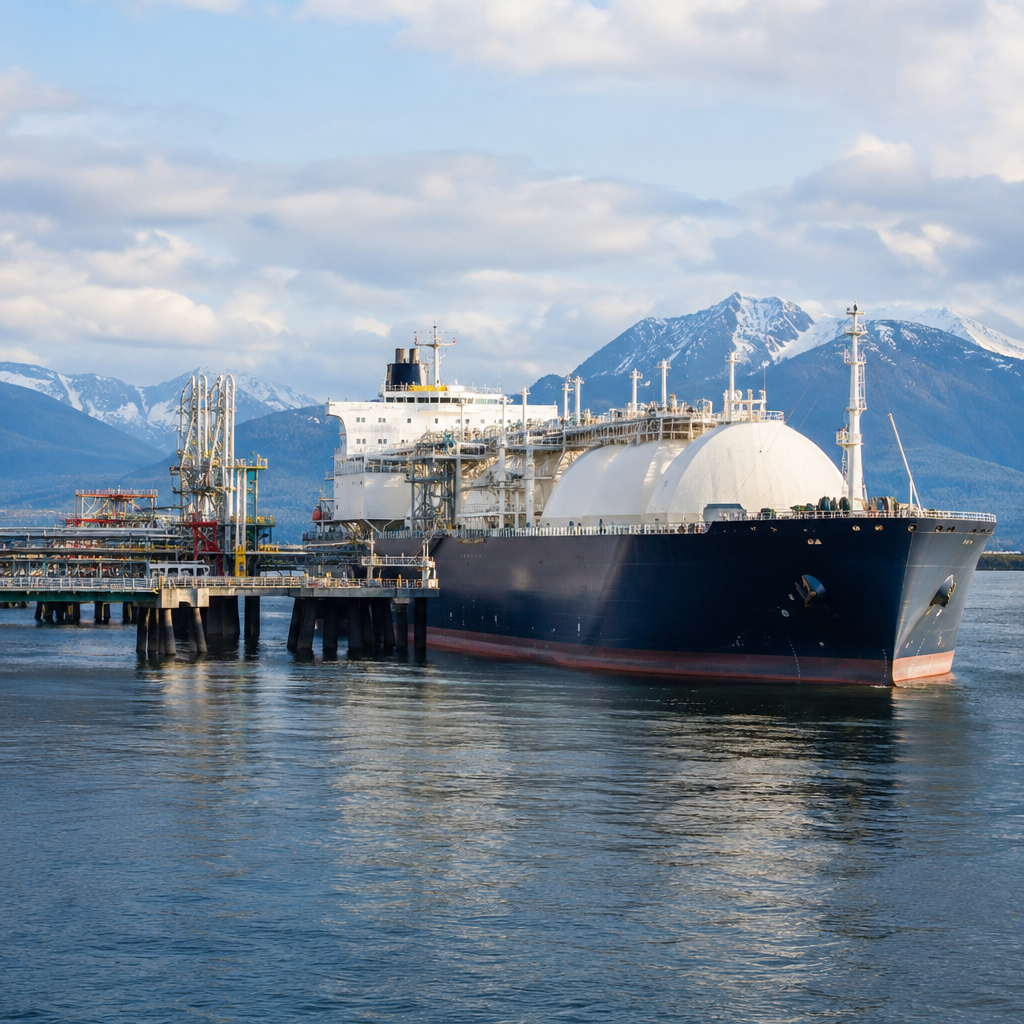
A new report from S&P Global Energy outlines the potential economic benefits of increasing Canada's liquefied natural gas exports, emphasizing the interconnectedness with the oilsands and petrochemical sectors.
CALGARY, ALTA. — A recent study conducted by S&P Global Energy underscores the significant economic advantages that could arise from enhancing Canada's capacity to export liquefied natural gas (LNG). The report indicates that scaling up LNG exports would not only elevate the financial performance of companies involved in its production but also generate positive spillover effects across the oilsands and petrochemical industries.Canada aims to produce as much as 100 megatonnes of LNG annually by the year 2040, a target that, if achieved, would position the country as the third-largest global supplier of LNG. Currently, projections suggest that Canada is on a trajectory to produce around 36 megatonnes per year by 2050. The research firm emphasizes that to bridge this considerable gap, substantial investments in infrastructure, particularly pipelines, are essential, alongside a tripling of drilling activities in the gas fields of Alberta and British Columbia.
Daniel Yergin, vice chairman at S&P, elaborated in an interview that Canada’s standing in the global energy market remains underwhelming when compared to its inherent competitive advantages in natural resources and advantageous geographic positioning. He noted, “It can be a great power,” highlighting the potential for Canada to leverage its resources without facing significant transportation choke points.
An increase in drilling activities would also lead to a heightened output of natural gas liquids (NGLs)—valuable components such as propane, butane, and ethane that are extracted alongside conventional natural gas. NGLs play a critical role as feedstocks for petrochemical production and fertilizers, as well as serving as fuels for cooking and transportation in various regions worldwide. They are also vital in blending with the near-solid bitumen from oilsands, facilitating its flow through pipelines, commonly referred to as condensate or diluent.
Kevin Birn, S&P’s chief Canadian energy analyst, emphasized that the narrative surrounding LNG exports transcends mere LNG discussions. He stated, “It is a very powerful NGL story,” and underscored the mutual dependency between the growth of LNG exports and the economic viability of the oilsands. The report posits that for Canada to maximize economic returns from its oilsands, a simultaneous expansion of LNG capabilities is necessary.
The study reveals that NGLs constitute approximately 25% of the total output from a typical Canadian gas well, yet they account for nearly 50% of the well's revenue value. Under an “accelerated development” scenario envisioned in the report, an increase in condensate supply could support the production of 1.2 million barrels per day from oilsands at its projected peak in 2040. Furthermore, S&P forecasts that overall NGL production could nearly triple by 2050, generating an estimated $300 billion in economic value for Canada.
🏷️
LNG
Canada
natural gas
energy exports
petrochemicals
Infrastructure
drilling
oilsands
NGLs
Pipelines
Next Article →
Cameron Betts Elected as New Chair of the British Columbia Construction Association2 days ago