Texas GulfLink Deep-Water Terminal Project Begins Construction to Enhance U.S. Oil Exports
📅 2 months ago
Construction has commenced on the Texas GulfLink deep-water terminal, a project aimed at enhancing U.S. crude oil exports and reducing environmental impact, supported by the U.S.–Japan Trade Agreement.
The evolution of Texas’s deep-water ports has been influenced by changing trade requirements and advancements in infrastructure for over a century. Before the annexation of Texas in 1845, early ports such as Galveston and Velasco primarily engaged in trade with New Orleans. By the mid-1800s, Galveston emerged as a prominent cotton exporter to Britain. The post-Civil War era saw an increase in ocean commerce and the expansion of railroads, leading to a rise in port traffic. However, shallow-water ports faced challenges as shipping vessels grew larger, prompting initiatives to establish genuine deep-water facilities. A pivotal moment in this development occurred in 1914 with the dredging of the Houston Ship Channel, which established what is now known as Port Houston and solidified the city’s position in global shipping.More recently, in 2015, Texas Deepwater Partners was formed as a joint venture to develop an energy logistics terminal along the Houston Ship Channel. This facility, covering 988 acres, is designed for multi-modal operations that enhance liquid storage and transportation, thereby increasing export capacity amidst a backdrop of rising energy production.
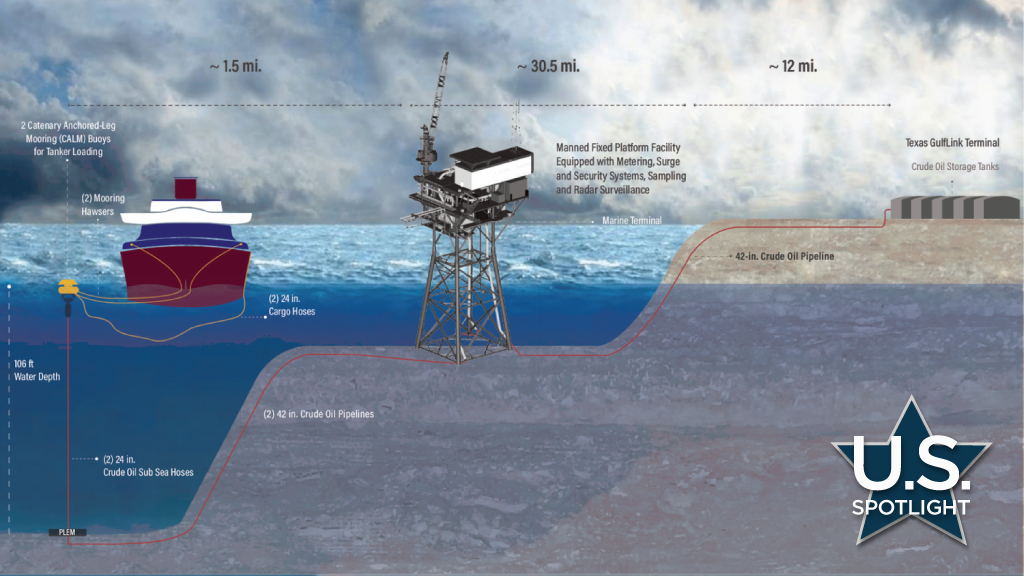
Currently, in light of the ongoing conflict in Iran, U.S. oil exports have surged to record highs. In response, Sentinel Midstream, a Dallas-based energy infrastructure firm, is embarking on the construction of a multibillion-dollar offshore oil-shipping hub in the Gulf of Mexico, located approximately 30 miles off the coast of Brazoria County, west of Freeport. The Texas GulfLink deep-water terminal is being developed with financial backing from an unexpected partnership between Japan and the Donald Trump administration, amidst a climate where private U.S. energy developers are hesitant to undertake financial risks without securing long-term commercial contracts first.
According to data from the U.S. Commerce Department, the U.S.–Japan Trade Agreement is projected to contribute approximately $2.1 billion to the project, which was the originally announced cost. Commerce Secretary Howard Lutnick emphasized that the project is set to “reinforce America’s position as the world’s leading energy supplier.” The Texas GulfLink project aims to create a terminal capable of loading Very Large Crude Carriers (VLCCs) directly offshore, which would simplify and enhance U.S. crude oil exports. Initial plans for this project were set in motion in January 2026, following the receipt of a deep-water port license from the U.S. Maritime Administration. Shortly after, on May 4, Sentinel Midstream confirmed funding from the U.S.–Japan Trade Agreement, allowing construction to commence immediately.
This development is expected to generate around 720 jobs in construction and operations, as reported by the U.S. Transportation Department, with operations anticipated to begin in 2028. The terminal is designed to accommodate up to two million barrels of crude oil per day, promising to improve operational efficiency while minimizing environmental impact. CEO Jeff Ballard of Sentinel remarked, “Texas GulfLink is about more than infrastructure; it is about unlocking the full potential of American energy,” emphasizing its role in enhancing global market access for U.S. producers.
The project is expected to open new international markets for the growing domestic crude production, particularly in Asia, where VLCCs are deemed optimal for transport. However, the deep drafts of these vessels complicate loading at existing near-shore ports, making it both costly and inefficient. Traditionally, VLCCs have relied on a method known as “reverse lightering,” where smaller tankers transport crude oil from the port to larger vessels anchored offshore, a process that is not only repetitive but also generates significant emissions. Sentinel asserts that the Texas GulfLink terminal will provide a more efficient solution by allowing VLCCs and other tankers to be loaded directly at the offshore facility, thus reducing emissions by approximately 86% compared to reverse lightering.
Additionally, the terminal will help alleviate congestion at nearshore ports, contributing to improved environmental performance and maritime safety. A notable feature of the terminal is its innovative vessel-based vapor recovery system, which utilizes a dynamic-positioning support vessel to capture volatile organic compounds (VOCs) during loading. This system is the first of its kind in the U.S. and is expected to prevent the release of up to 19,000 tons of VOCs, including hazardous air pollutants, annually.
Given the unpredictable nature of the offshore environment and the increasing size of oil tankers, Sentinel stresses the importance of meticulous design, construction, and operation of the Texas GulfLink facility to mitigate risks to environmental health and safety. U.S. Transportation Secretary Sean Duffy affirmed that the Texas GulfLink project aligns with efforts to bolster the domestic oil industry, positioning American producers to be leaders in the global market, ensuring that the world can depend on the United States for its energy needs rather than foreign adversaries.
🏷️
crude oil
deep-water terminal
energy infrastructure
Texas GulfLink
environmental impact
maritime safety
Brazoria County
oil exports
VOCs
U.S.–Japan Trade Agreement
← Previous Post
Revolutionizing Concrete Quality Control: Real-Time Monitoring of Admixtures2 months ago