Amtrak's $6 Billion B&P Tunnel Replacement Project Gains Momentum
📅 2 weeks ago
Amtrak's ambitious Baltimore & Potomac Tunnel Replacement Program is progressing rapidly, promising to enhance rail service reliability between Baltimore and Washington. With significant construction milestones achieved and a completion target set for 2036, the project is set to modernize one of the oldest rail bottlenecks in the U.S.
Construction efforts are intensifying on Amtrak’s $6 billion Baltimore & Potomac (B&P) Tunnel Replacement Program, recognized as one of the most significant rail infrastructure initiatives in North America. This extensive project aims to eliminate a notorious bottleneck on the Northeast Corridor, thus facilitating more reliable passenger rail service connecting Baltimore, Washington, and Virginia. A pivotal aspect of this endeavor is the replacement of the current B&P Tunnel, which has been in operation since 1873 and is Amtrak’s oldest tunnel. The existing structure serves as a vital link on the busiest passenger rail corridor in the United States, accommodating millions of passengers annually. However, its deteriorating condition, coupled with challenges such as water infiltration, capacity limitations, and tight curves, has rendered it a primary source of delays, necessitating trains to reduce their speed to 30 mph when traversing through the tunnel.This replacement project, marking Amtrak’s largest single investment in infrastructure to date, will result in the development of a twin-tube tunnel system known as the Frederick Douglass Tunnel. According to Amtrak president Roger Harris, this transformation is essential for enhancing safety and reliability along the Northeast Corridor, which serves as America’s busiest passenger railroad. Harris emphasized that this investment is progressing with a clear strategy as they aim to open the new Frederick Douglass Tunnel by 2036. He also noted the importance of collaborative support from partners to tackle current and future challenges associated with the project.
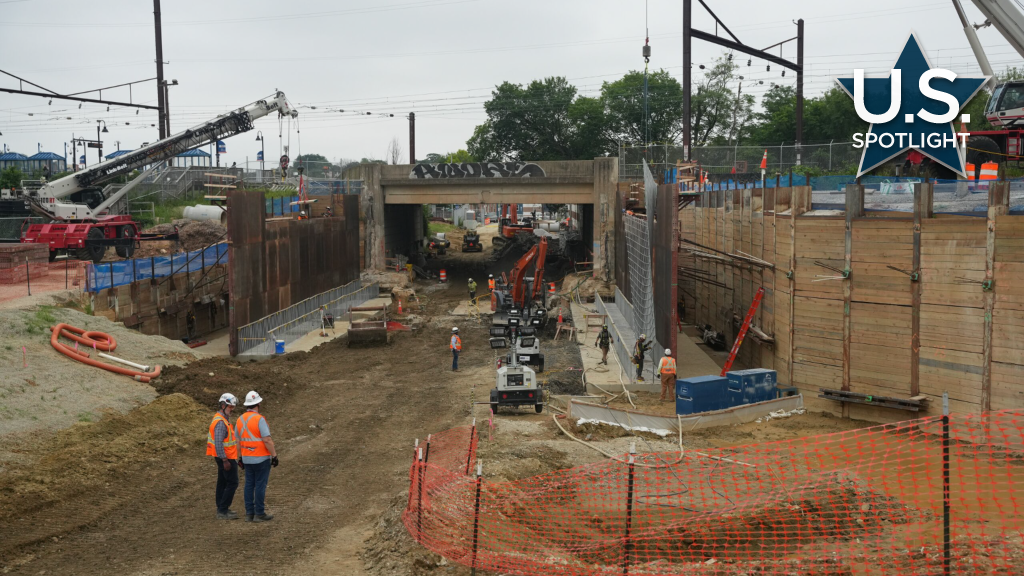
As of now, contractors have successfully completed excavation and initiated the installation of initial footings for the bridge over West Mulberry Street. Concrete placement and stabilization work for the bridge are currently in progress. The first major construction contract was awarded in late 2023, with utility relocation efforts anticipated to commence in 2024. Significant advancements have been made across various facets of the project, including the reconstruction of the West Mulberry Street railroad bridge, which is the first of five bridges scheduled for rebuilding to accommodate the future rail alignment.
In addition, crews have achieved a crucial milestone with a 345-foot-long utility siphon tunnel, which lies beneath the Northeast Corridor tracks. The contractor recently completed the final section of rock pillar separating both sides of the tunnel through controlled blasting. This utility tunnel is deemed an essential enabling project for the Frederick Douglass Tunnel, as it will house water, sewer, communications, and electrical infrastructure beneath both the current and future railroad tracks. Relocating existing municipal services is a prerequisite before major tunnel excavation can commence.
Work is now shifting towards rerouting utility lines through the new structure and reconnecting them to Baltimore’s municipal systems. Meanwhile, the manufacturing process is progressing for the two large tunnel-boring machines (TBMs) that will be responsible for excavating the new tunnel tubes. The first of these machines is over 50 percent complete and is on schedule for deployment in 2028. Construction is also underway for a substantial south portal launch pit, a 60-foot-deep excavation that will act as the starting point for the tunnel boring operation. As excavation concludes, the TBMs will be lowered into the pit and assembled underground.
In the upcoming months, extensive excavation, piling, and site preparation work will take place around the launch area as teams gear up for the transition from enabling works to full-scale tunneling. Ongoing utility relocations are taking place throughout the corridor, particularly near the future North Ventilation Facility and north portal area. At the West Baltimore MARC Station, construction is advancing on a relocated bus loop along with related accessibility enhancements. Furthermore, additional bridge replacements are progressing ahead of schedule, including the Mulberry Street structure, with future replacements planned for railroad bridges at Franklin Street and Warwick Avenue, as well as roadway bridges at Edmondson Avenue and Lafayette Avenue. The Lafayette Avenue bridge replacement will entail a complex multi-phase construction sequence and the temporary relocation of nearby park space.
To improve cost efficiency and constructability, Amtrak and the Federal Railroad Administration have spent over a year evaluating potential design optimizations. Several refinements have been integrated into the project without altering its overall scope. Notably, the elimination of a planned intermediate ventilation facility and its accompanying tunnel has reduced both costs and community impacts. Engineers have also adjusted the tunnel alignment by elevating sections of the route between 10 and 22 feet, which minimizes excavation volumes while adhering to safety standards. Other modifications include resequencing work and broadening opportunities for simultaneous construction activities. Despite the progress made, substantial work remains before the commencement of tunnel boring. Crews are actively engaged in soil stabilization, jet grouting, sewer installation, roadway modifications, and site mobilization activities throughout the project corridor. Once tunneling commences in 2028, the two TBMs will excavate separate tunnel tubes beneath Baltimore, establishing the foundation of a new rail corridor intended to serve the region for decades ahead. Following the excavation phase, crews will install tracks, power systems, communications infrastructure, ventilation equipment, and life-safety systems before the line is put into service.
🏷️
Amtrak
B&P Tunnel
Baltimore
utility relocation
tunnel-boring machines
public transportation
construction progress
rail infrastructure
Northeast Corridor
Frederick Douglass Tunnel
← Previous Post
United Against Alto Launches Campaign to Address Concerns Over Proposed High-Speed Rail Project2 weeks ago
Next Article →
Toronto's Western Beaches Plan Aims for Climate Resilience and Enhanced Visitor Experience2 weeks ago