Augmenta's Quest for Spatial AI: Bridging the Gap Between Geometry and Functionality in Construction
📅 4 months ago
🏷️ Augmenta
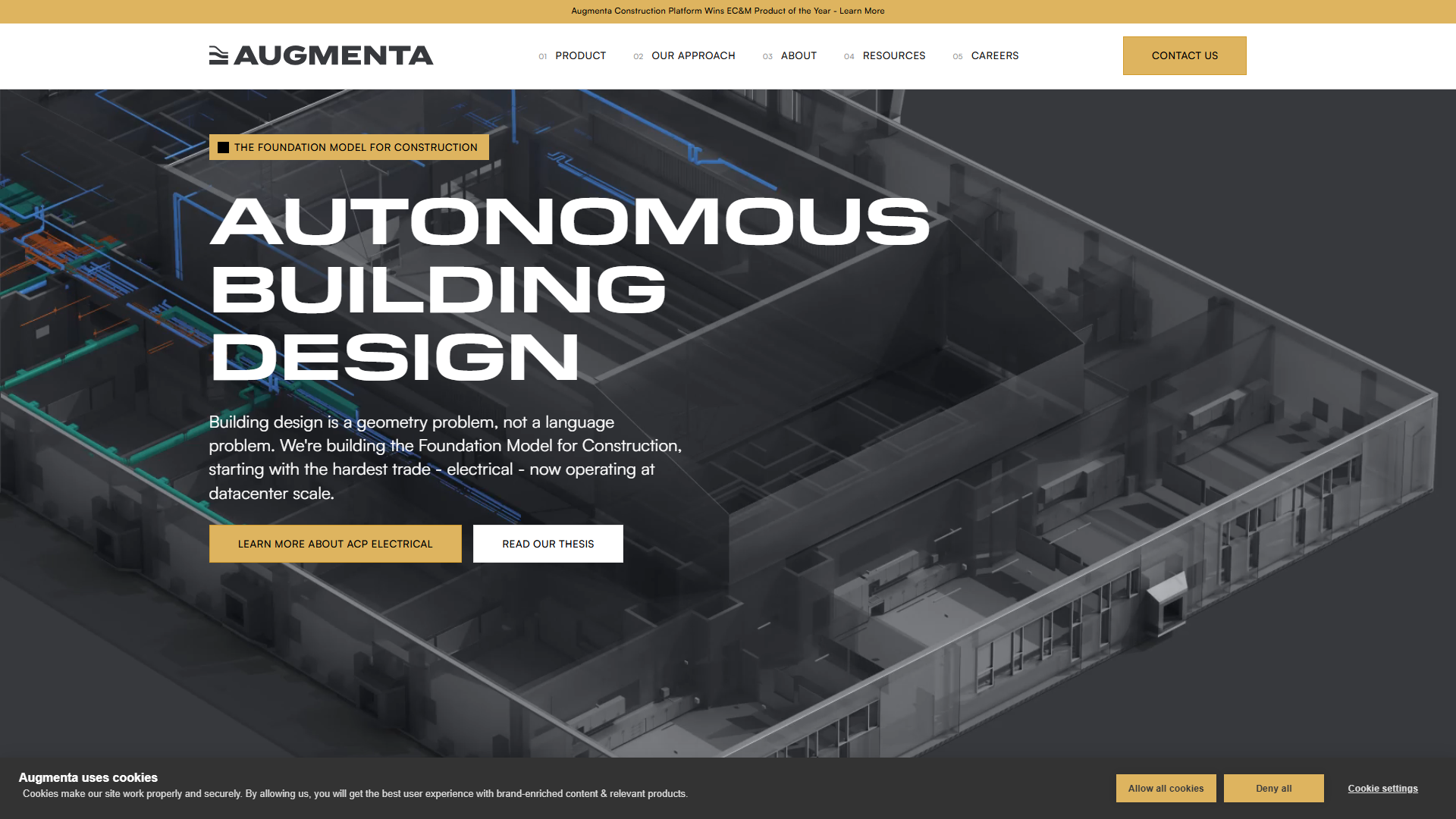
Augmenta explores the challenges of spatial reasoning in AI for construction, emphasizing the need for specialized models that understand the intricacies of building design.
In the realm of visual language models (VLMs), a perplexing phenomenon has emerged: despite their advanced capabilities, they often fail fundamental tests of spatial reasoning. A recent inquiry involving models like ChatGPT, Claude, and Gemini revealed that when shown an image of a hand with six fingers, these systems consistently report five, failing to accurately count the visible digits. This recurring misjudgment underscores a broader issue identified in a Stanford study, which introduces the concept of 'mirage reasoning.' This term describes how VLMs can generate elaborate descriptions and reasoning for images they have never actually encountered, leading to a false sense of visual comprehension.The implications of this limitation are profound, especially when considering the complexities of the physical world. Spatial reasoning encompasses various challenges, including occlusion, depth perception, and the intricate geometric relationships between objects. While VLMs excel at generating textual descriptions, their understanding of spatial configurations is fundamentally lacking. This gap between textual interpretation and the three-dimensional reality presents significant hurdles, particularly in fields that require precise spatial reasoning, such as architecture, engineering, and construction (AEC).
Reflecting on my journey in this field, I recognize that my research trajectory has been subtly steering towards the automation of building designs. My foundational work in structural analysis and the synthesis of three-dimensional shapes has illuminated the semantic richness embedded within geometry. The arrangement of parts and objects conveys relationships and functional intent, a principle that extends to the spatial organization of buildings.
Throughout my career, I have pursued various projects that highlight the importance of geometric understanding in design. From my work on symmetry hierarchies to generative models for 3D shapes, I have consistently focused on the relationship between geometry and functionality. The ultimate question in shape understanding transcends mere visual representation; it centers on the functionality of the design. In an era dominated by generative AI, it is crucial to differentiate between designs that merely appear correct and those that are genuinely functional.
As I prepare to present at CDFAM Barcelona 2026, I am driven by a vision for AI that transcends simple geometric description. I envision a system that comprehends and generates outputs that are physically coherent and operationally valid. The construction industry, despite its vast market size, remains one of the slowest adopters of AI technology, facing unique challenges that complicate automation. The complexity of designing a hospital floor, for instance, involves navigating millions of spatial constraints, with stringent requirements for clearance, constructibility, and compliance with regulations.
In construction, no two projects are identical, making it economically challenging to disseminate design costs across multiple units. Unlike product design, where scalability diminishes per-unit expenses, construction projects bear the full weight of their unique design efforts. Despite this pressing need for computational design solutions, the industry has yet to fully embrace automation. Every decision regarding routing, placement, and trade coordination remains largely manual, a reality that has only recently begun to shift with advancements in digital modeling and computational power.
My partnership with Augmenta stems from a shared recognition of the urgent need for a robust computational design engine within the construction sector. At Augmenta, we are addressing the complexities of spatial AI through a two-layer approach. The first layer focuses on developing a computational engine capable of generating geometrically valid, constructible 3D designs based on building information models. This layer is foundational, as it ensures that the outputs meet the rigorous demands of the physical world.
The second layer involves AI reasoning, which interprets design intent and navigates trade-offs, relying on large language models and geometric deep learning to create an intelligent interface for the computational engine. This interface must provide rapid feedback to support the iterative nature of building design, as designers continuously refine their intent in response to emerging constraints. The interplay between these two layers is essential for creating a functional AI that not only generates data but also learns and improves through real-world application.
As we advance in our efforts, we are acutely aware of the distinction between general-purpose models and specialized systems tailored for the specific demands of construction. General-purpose foundation models often lack the precision required for spatial design automation, a gap that cannot be bridged by mere scaling or prompt engineering. At Augmenta, we are committed to creating a foundation model for 3D building design that incorporates deep construction intelligence, ultimately enabling the synthesis of fully engineered 3D buildings from diverse inputs. Our work targets the most challenging aspects of construction design, focusing on mechanical, electrical, and plumbing (MEP) systems, where precision and expertise converge.
In conclusion, the journey toward functional AI in construction is both complex and critical. The gap between visual plausibility and physical understanding remains significant, but through our efforts at Augmenta, we aim to bridge this divide and redefine what is possible in the realm of building design and construction.
🏷️
construction automation
MEP systems
geometric understanding
3D modeling
building design
AI in Construction
generative design
spatial reasoning
functional AI
construction technology
Next Article →
The Impact of AI on Data Center Construction: Challenges and Innovations for Electrical Contractors4 months ago