The Impact of AI on Data Center Construction: Challenges and Innovations for Electrical Contractors
📅 4 months ago
🏷️ Augmenta
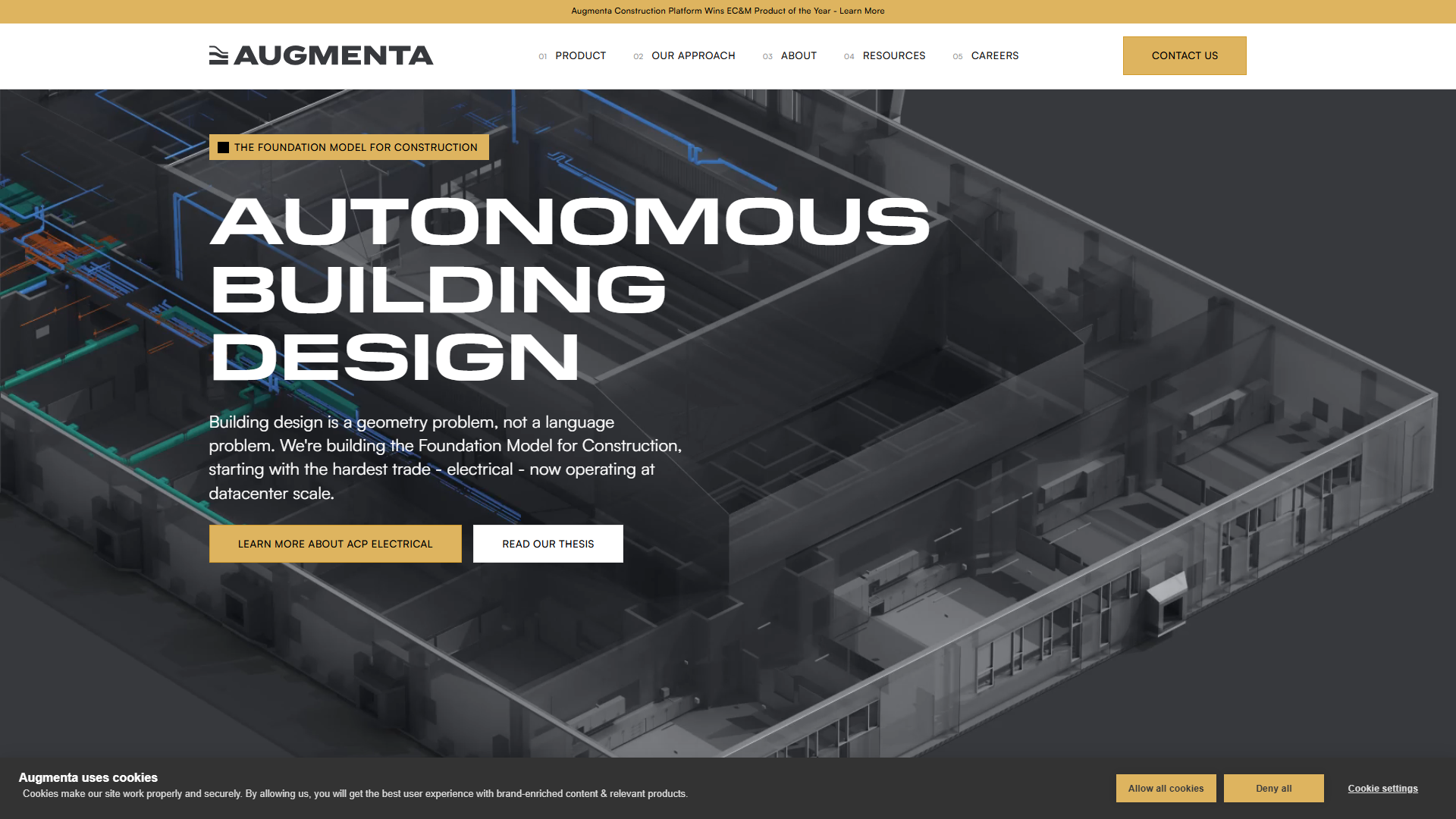
Augmenta's CEO discusses the implications of AI in data center construction, highlighting the unique challenges faced by electrical contractors and the potential for innovative solutions to enhance efficiency.
As discussions around the infrastructural demands of artificial intelligence continue to escalate, the financial figures being thrown around are striking. By the year 2030, it is anticipated that technology firms will allocate around $7 trillion towards global data center development. Of this staggering total, approximately $1.4 trillion is earmarked specifically for the mechanical, electrical, and plumbing (MEP) systems essential to the operation of these facilities. However, the focus here should shift to what this financial projection signifies for the professionals tasked with constructing such complex structures.Data centers represent a unique challenge within the commercial building sector. The construction costs attributed to MEP systems in these facilities range from 40 to 55 percent, a significant increase compared to the 15 to 25 percent typical for standard commercial buildings. At the heart of these systems lies the electrical installation, which is critical to the overall functionality of the facility. Every detail, from conduit runs to raceway routing, directly influences power consumption, construction expenses, and the timeline for getting the building operational. Unlike most commercial projects, where electrical considerations come late in the design process, data centers require a complete inversion of this model: electrical planning must take precedence.
The design of GPU racks involves intricate physics simulations, while cooling systems are meticulously modeled. However, the electrical design process is still predominantly manual, relying heavily on the expertise of engineers and virtual design and construction (VDC) teams. This is not a critique of these professionals, who are among the most skilled in the industry, but rather an observation that their tools have not evolved in tandem with the complexities they face.
The pressure on electrical contractors has reached unprecedented levels. Major developers, often referred to as hyperscalers, cannot tolerate delays in their data center projects, with potential losses of up to $14.2 million per month due to revenue loss, overruns, and penalties. Despite this urgency, the handoff of design responsibilities to electrical contractors remains one of the most rushed stages in construction. Electrical teams often receive the least detailed documentation at the outset and must navigate tight coordination challenges, all while being expected to deliver a fully coordinated model before the initial BIM (Building Information Modeling) meeting.
Compounding these pressures is the impending retirement of a significant portion of the construction workforce. By 2031, it is estimated that 41 percent of the workforce will retire, including many experienced VDC professionals who can adeptly manage the routing of extensive electrical systems within vast facilities. This demographic shift presents a paradox: the demand for skilled labor is increasing while the supply is dwindling.
In the last two years, the construction industry has witnessed an influx of AI tools, many based on Large Language Models (LLMs). While some of these tools offer value in areas such as specification parsing and contract review, they fall short in addressing the spatial complexities inherent to construction projects. Successful electrical design requires an advanced AI capable of spatial computations that reflect the intricate geometry of real buildings—something that current LLMs cannot accomplish. At Augmenta, we are developing this specialized AI to meet the demands of our industry.
For instance, our platform has significantly reduced the time required for electrical modeling on a 330,000 square foot data center from 320 hours to just 96 hours—recovering approximately 28 working days on the initial model. In another case, our technology facilitated the routing of over 18 miles of electrical conduit in merely 72 hours, a task that would typically take weeks by hand. Our collaborations extend to major electrical contractors engaged in building data centers for prominent U.S. hyperscalers, where optimized electrical routing has led to minor but vital energy efficiency improvements and reductions in material waste.
It is important to clarify that while our technology streamlines the process, it does not eliminate the role of engineers. Instead, it alleviates them from redundant tasks, allowing them to concentrate on critical decision-making aspects such as constructability reviews and coordination challenges. The goal is not to replace human judgment but to enhance the capabilities of VDC teams by freeing up their time and mental resources.
Looking beyond data centers, our vision at Augmenta is broader. We aspire to establish high-performance building design as the standard across all projects, not merely those with substantial budgets. Traditionally, the high costs associated with transitioning to more efficient processes have been a deterrent. However, our automation of core building system design not only expedites the process but also allows for more thoughtful decision-making—benefits that can be realized on a large scale. Currently, data centers are at the forefront of testing these capabilities due to their high stakes and tight timelines. Yet, the same spatial AI technology we employ for electrical routing in these facilities is also applicable to hospitals, schools, and various infrastructure projects where precision in design is crucial for long-term success. As the conversation about the infrastructural needs of AI continues, it becomes increasingly clear that the construction of this infrastructure necessitates the integration of AI solutions.
🏷️
MEP systems
electrical contracting
automation
AI in Construction
high-performance building design
Infrastructure
data centers
sustainability
VDC teams
construction technology
← Previous Post
Augmenta's Quest for Spatial AI: Bridging the Gap Between Geometry and Functionality in Construction4 months ago
Next Article →
Owen Electric's VDC Team Leverages AI for Enhanced Coordination in Large-Scale Projects4 months ago