
July Housing Market Data Shows Stability Amid Shifting Dynamics
📅 2 months ago
🏷️ Canadian Real Estate Association
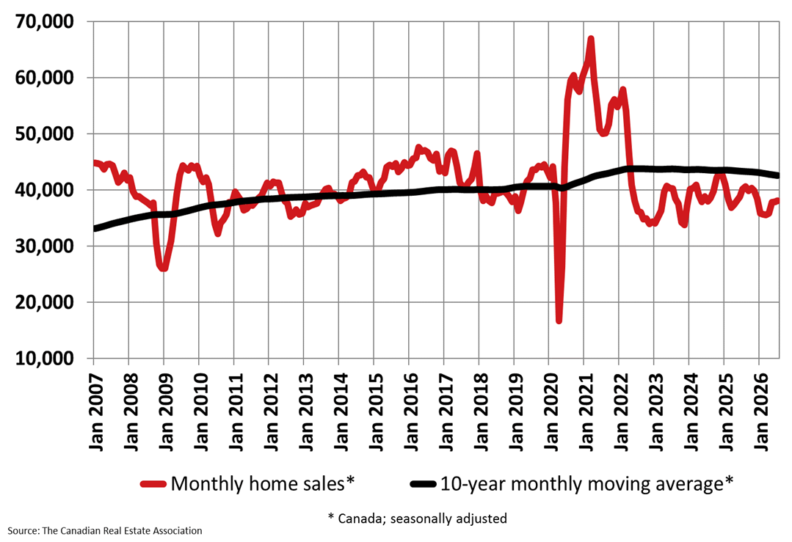
The Canadian housing market showed signs of stabilization in July 2026, with slight increases in home sales and a decrease in listings, indicating a shift towards a more balanced market across various regions.
In July 2026, the Canadian housing market exhibited a consistent trend compared to June, with a modest uptick in home sales, a decline in property listings, and stable prices, according to Shaun Cathcart, Senior Economist at the Canadian Real Estate Association (CREA). He noted that while national figures reflect these changes, a deeper analysis reveals a gradual return to balance across various markets in the country. Regions such as the Prairies, Quebec, and the East Coast have seen a cooling off of what were previously sellers' markets over the past year. Notably, British Columbia's Lower Mainland and Ontario's Greater Golden Horseshoe have shifted from either buyers' markets or marginal buyers' markets back to a state of balance.The July highlights indicate a 0.5% month-over-month increase in national home sales, though actual activity was still 5.3% lower than in July 2025. The number of new listings fell by 1.6% month-over-month, marking the third consecutive drop. The MLS® Home Price Index (HPI) recorded a slight increase of 0.1% from June but showed a year-over-year decline of 3.3%. In contrast, the national average sale price rose by 0.2% year-over-year, reaching $674,819 in July 2026.
As new listings continued to decline, the national sales-to-new listings ratio tightened to 51.3% in July, approaching the long-term average of 54.7%. This metric suggests a movement towards balanced market conditions, which are typically characterized by ratios between 45% and 65%. Garry Bhaura, CREA Chair, emphasized that this transition towards a more normalized balance between supply and demand is beneficial for buyers, alleviating concerns about property values decreasing and reducing the pressure of competing offers.
At the end of July 2026, there were 205,388 properties listed for sale across all Canadian MLS® Systems, a slight annual increase of 0.6% and just 1.5% above the long-term average for this time of year. The months of inventory available nationally was recorded at 4.7, the lowest for the year thus far and below the long-term average of 5 months. This measure indicates a seller's market if below 3.6 months and a buyer's market if above 6.4 months. Most provinces have been moving towards average levels of inventory, with only Saskatchewan, New Brunswick, and Newfoundland and Labrador remaining in borderline sellers' market conditions.
Interestingly, even Ontario's inventory measure was only about half a standard deviation above average in July, a notable shift from the buyers' market conditions experienced in the first four months of 2026. The National Composite MLS® HPI's increase of 0.1% from June to July marked the first rise since November 2024, while year-over-year declines have been lessening since January, with July's reading showing the smallest decrease since October 2025.
As the market evolves, the next CREA statistics package is anticipated to be released on September 15, 2026. This report will continue to provide insights into national trends, though CREA advises that while average price information can illustrate trends over time, it does not reflect actual prices in diverse neighborhoods or account for price variations across different geographic areas. The data encompasses all types of housing and utilizes MLS® Systems, which are collaborative marketing platforms employed by Canada’s real estate boards to enhance property visibility.
🏷️
residential construction
housing trends
market balance
Canadian housing market
home prices
MLS
real estate
CREA
property listings
home sales
Next Article →
Canada Lands Company Transitions to Build Canada Homes to Enhance Housing Development2 months ago