Revamping the Blue Water Bridge: A Major Overhaul for Enhanced Traffic Management
📅 5 months ago
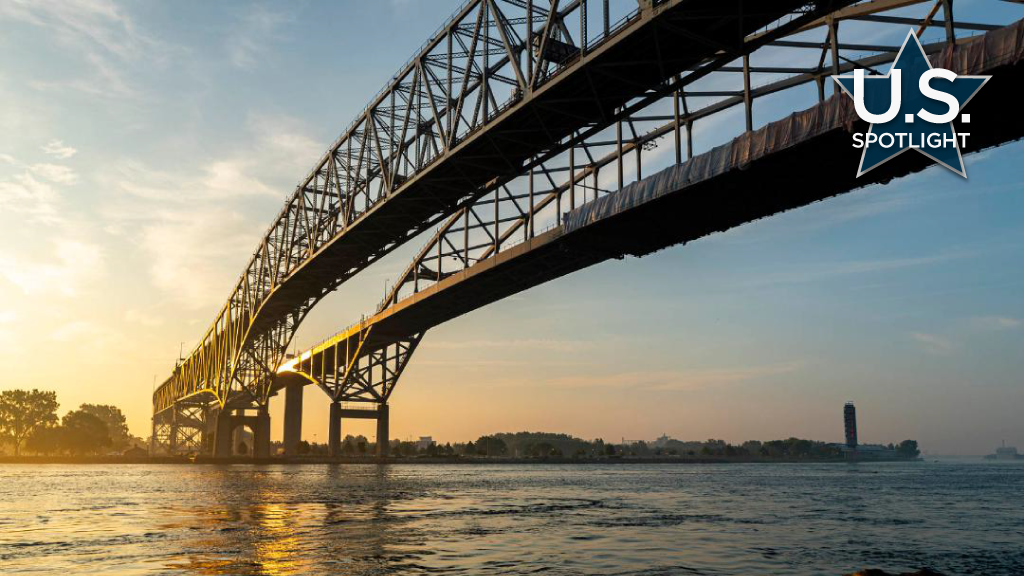
A significant renovation of the Blue Water Bridge is underway, focusing on improving traffic flow and safety at one of North America's busiest border crossings.
The Blue Water Bridge, a key artery for international trade between Canada and the United States, is currently undergoing substantial renovations aimed at enhancing local community access and traffic patterns, as well as reconfiguring operational facilities. Historically, the Ambassador Bridge connecting Windsor and Detroit was known as North America’s busiest trade crossing; however, in the previous year, it was overtaken by the Blue Water Bridge, which recorded 2.1 million commercial crossings compared to the Ambassador's 1.9 million. This shift is largely attributed to truckers opting for the Blue Water Bridge due to significantly lower tolls, which stand at $7 per axle compared to the Ambassador Bridge's $27.This extensive undertaking is part of a multi-decade strategy to revamp the American port of entry and its associated access routes. Some preliminary works, including a freeway interchange and a welcome center, were completed a decade ago, but funding constraints have hindered progress on the current enhancements to the bridge plaza. The Michigan Department of Transportation (MDOT) has successfully completed the first phase of construction, which began last year, and is preparing to initiate the second phase this summer. Further phases are planned, but their execution is dependent on federal funding approvals.
The existing six-lane bridge consists of two structures: one dating back nearly a century and the other constructed in the 1990s. The U.S. port of entry is positioned approximately 1,000 feet inland from the St. Clair River, with direct connections to Interstates 94 and 96, which have been the focal points for addressing longstanding traffic and access challenges.
The first phase of the project involved relocating Exit 275 from eastbound I-94, reconfiguring a vital local city intersection, and installing noise walls and landscaping. The upcoming second phase will expand the toll plaza southward. A significant aspect of this phase is the redesign of an unusual off-ramp leading to a duty-free store on Pine Grove Avenue. Currently, Canadian-bound motorists who purchase items at the duty-free store face restrictions when re-entering the United States, which has led to trucks circumventing freeway traffic by using the duty-free parking lot as a shortcut. The redesign will incorporate the duty-free store within the plaza’s footprint to alleviate this issue.
For safety enhancements, a building for secondary inspections will be constructed behind the U.S. customs primary booths, addressing the current lack of a designated facility for such inspections, which has posed safety risks with customs officers directing vehicles on the plaza. Additionally, plans include a new administration building for MDOT and an adjacent equipment storage facility for specialized maintenance equipment necessary for the upkeep of the complex long-span bridges. A new customs inspection building will also be established, designed for semi-trucks to pass through for non-intrusive inspections using X-ray technology.
The project will also see the construction of five bridges or ramps to facilitate the elevation required for the expansion, as the existing plaza is situated about 30 feet above ground level. Project manager Carrie Warren noted that while challenges are inherent in civil engineering, the experienced team has largely anticipated many of the obstacles encountered throughout the project’s development.
The aim of the renovations is not to increase capacity for more traffic but to better separate local and international traffic, which has been a source of congestion, particularly involving the duty-free store. The second phase is expected to complete by 2030. Throughout the renovation process, efforts have been made to minimize disruptions to cross-border traffic, although this has contributed to extending the timeline for project completion. The final two phases remain uncertain, with the third phase planned for northern expansion to accommodate secondary commercial inspections and the fourth phase focused on refurbishing the existing plaza to add more inspection lanes and a new administrative building. However, these phases are contingent upon federal funding commitments, with the project team awaiting the federal government's ability to secure leases and occupancy arrangements if construction proceeds.
🏷️
federal funding
Infrastructure
Michigan Department of Transportation
international trade
Construction
Blue Water Bridge
commercial crossings
traffic management
safety enhancements
border crossing
← Previous Post
Canada's Trade Diversification Efforts Yield Mixed Results, Report Reveals5 months ago