Hamilton Unveils $390.4 Million Birch Transit Centre for CNG and Future Electric Buses
📅 4 months ago
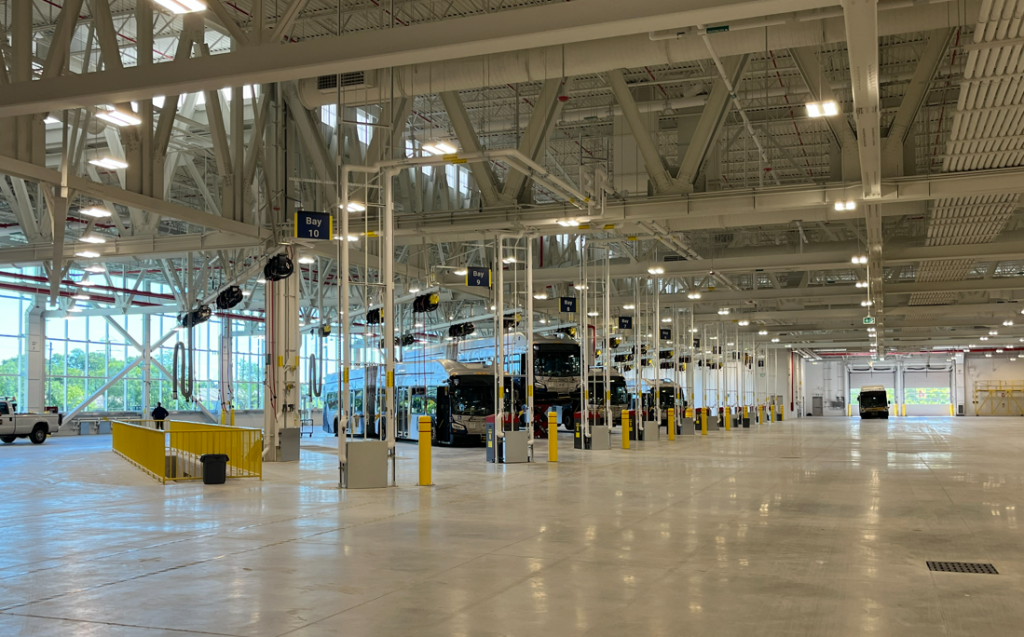
The Birch Transit Centre, a $390.4 million facility in Hamilton, integrates current CNG bus support with future provisions for electric buses, enhancing the city's transit capabilities.
The recently completed Birch Transit Centre in Hamilton represents a significant investment in public transportation, costing approximately $390.4 million. This facility is specifically designed to accommodate Hamilton's compressed natural gas (CNG) public bus fleet, which holds the distinction of being the largest in Ontario. Notably, the centre also includes structural, spatial, and electrical provisions to facilitate a future transition to battery-electric buses, reflecting the city's commitment to evolving its transit infrastructure.Occupying a 24-acre site, the Birch Transit Centre spans 400,000 square feet and was constructed by general contractor Pomerleau Inc. over a period of three years. The facility features indoor bus storage, two dedicated CNG fuelling lanes, 30 maintenance bays, two bus washing systems, and administrative offices. CNG has played a crucial role in Hamilton's public transportation system, particularly through the Hamilton Street Railway, which has utilized this fuel for decades. However, the new transit centre stands out as it uniquely combines the existing CNG technology with the necessary infrastructure to support battery-electric propulsion in the future.
Eric Czerniak, principal and market sector lead for operations and maintenance facilities at Arcadis Canada Inc., the project's lead designer, emphasized the innovative nature of the transit centre. He noted that the design process was akin to solving a complex jigsaw puzzle, as the team had to navigate various design iterations to meet the needs of both the current CNG fleet and the anticipated electric-powered fleet.
To comply with CNG code requirements, the transit centre incorporates advanced safety features, including methane gas detection systems, automated logic controls, and an integrated building automation system (BAS) for managing ventilation, alarms, and emergency shutdown protocols. The design team faced numerous challenges during the master planning phase, ultimately arriving at a solution that caters to stakeholder requirements.
Provisions for future electric bus infrastructure are also a key component of the Birch Transit Centre. The roof has been engineered to support roof-mounted pantograph systems, which are essential for charging electric buses, as well as to accommodate heavier loads that electric buses will impose. Additionally, plans include the installation of an indoor battery-electric bus substation, ensuring that Hamilton is prepared for the potential shift towards zero-emission vehicles as they become more economically viable.
The Birch Transit Centre is constructed primarily from concrete and steel and features long-span trusses that create column-free garage space. The project aims to meet many of the principles of LEED Silver certification, focusing on energy efficiency and water conservation. The roof structure is also designed to support future solar panel installations, further enhancing its sustainability.
Czerniak pointed out that one of the reasons for the lengthy development timeline of several years was due to extensive pre-enabling works required at the site. This included acquiring additional land, demolishing existing buildings, relocating tenants, and addressing soil contamination from old foundations and abandoned steel. To improve the soil's bearing capacity without incurring excessive costs, the team employed methods such as rammed aggregate piers and small-diameter anchors drilled deep into the ground.
Reflecting on the project's timeline, Czerniak mentioned that he has been involved in the transit maintenance facility for nearly nine years. While this duration may seem lengthy, he stated that for a project of this scale and complexity, it falls within industry norms. He suggested that eliminating unforeseen funding delays could potentially shorten the development timeline to around seven years.
Funding for the Birch Transit Centre was secured through a tri-government financing model, which includes $142.8 million from the federal government, $92.6 million from the Ontario government, and $155 million from the City of Hamilton. Czerniak confirmed that the project was completed on budget, marking a significant achievement for all parties involved.
🏷️
sustainability
Hamilton
Construction
Infrastructure
public transportation
LEED Silver
electric buses
Birch Transit Centre
Pomerleau Inc.
CNG buses
← Previous Post
Major Affordable Housing Development Set to Transform Downtown St. Catharines4 months ago
Next Article →
NAIOP Rebrands as Commercial Real Estate Development Association to Reflect Industry Evolution4 months ago