The Hive: Vancouver’s New Landmark Office Building Completes Structural Phase
📅 5 months ago
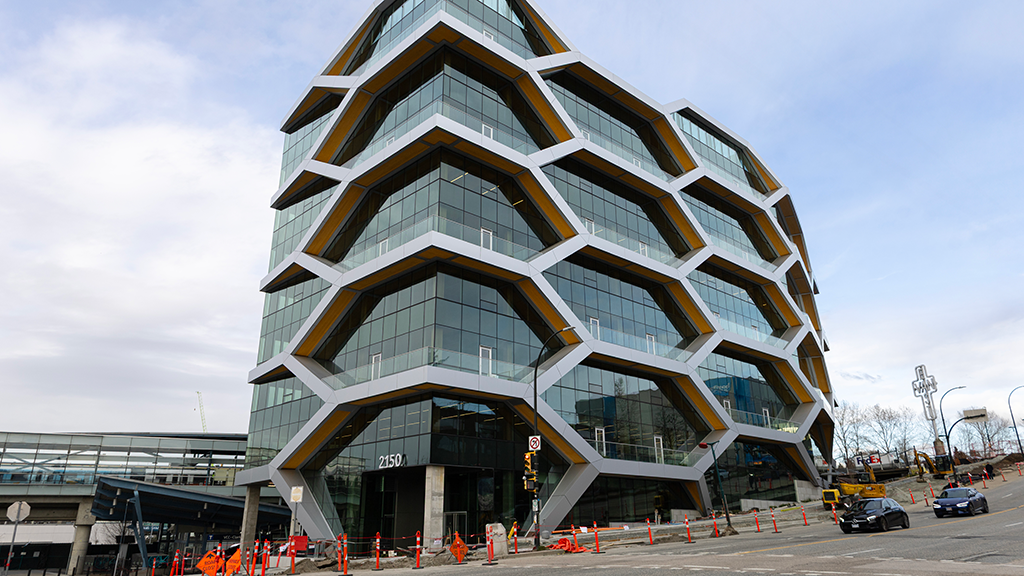
The Hive, North America's tallest mass timber seismic-resistant building, has reached structural completion, becoming a significant addition to Vancouver's skyline.
After a decade of innovative thinking and problem-solving, The Hive office building in Vancouver has achieved structural completion, with only the interior fit-out left to finalize. This remarkable structure, designed by Dialog for the owner Nature’s Path, stands as the tallest mass timber seismic-resistant building in North America. Its unique honeycomb-shaped exoskeleton is set to become a defining feature of Vancouver’s skyline, especially for travelers arriving via Keith Drive or the SkyTrain through False Creek Flats.The Insurance Corporation of British Columbia has secured a lease for the entire 164,000-square-foot building, planning for a potential occupancy date in June 2027. The project’s development management was handled by BentallGreenOak, and Ventana Construction served as the general contractor.
Martin Nielsen, a partner at Dialog, expressed his enthusiasm for the project, highlighting its triple bottom line approach. "It addresses environmental concerns by utilizing wood, which sequesters carbon and avoids the emissions associated with concrete. Moreover, it bolsters the B.C. economy by sourcing wood locally. Finally, it provides an aesthetically pleasing workspace," he stated.
The Hive incorporates 106 Tectonus seismic damper connections as part of a perimeter braced structural system designed to enable the building to self-center after seismic events. This technology, initially developed in New Zealand following their earthquakes, underwent extensive testing at the University of Alberta, which included large mockups to ensure effectiveness.
The project received $4 million in research funding from both federal and provincial governments, which aided in mass timber destructive testing, constructability analysis, and fire safety testing. Nielsen noted that the funding was instrumental in producing reports that assured building inspectors of the mass timber seismic scheme's efficacy and addressed insurance concerns.
Nielsen elaborated on the functionality of the joints during seismic events, explaining, "These joints allow the entire building to sway with the seismic forces, dissipating them and returning to a vertical position. That’s a powerful concept."
The design process was collaborative, with Nielsen, who possesses both architectural and mechanical engineering expertise, working alongside his team. Notably, the design evolved significantly during discussions with Paul Fast and Robert Jackson from Fast+Epp, leading to the innovative decision to position the shear-resisting members at the perimeter. This strategy not only decluttered the building's core but also enhanced the interior layout's efficiency.
Mass timber was considered from the outset, but the decisive moment for Nature’s Path came with the construction of an 18-storey mass timber student residence at UBC, which demonstrated the material's viability. The wood for The Hive was sourced from Kalesnikoff, a local B.C. firm.
According to Dialog, The Hive's greenhouse gas emissions and energy consumption are projected to be 80% below the median for its building type. Sustainability features include triple-glazed windows for noise reduction and a water system certified as salmon-safe. The building operates on electrification and is designed to be essentially zero carbon. Furthermore, it has achieved LEED Gold certification.
Nielsen concluded by expressing hope that The Hive will inspire future generations of developers to explore similar sustainable office building projects. "There’s going to be a whole other generation of developers who are going to look at The Hive and say, ‘Hey, can we do this?’" he remarked.
🏷️
construction innovation
nature's path
local economy
Vancouver
sustainable building
Mass Timber
seismic resistance
environmental design
LEED Gold
office buildings
← Previous Post
Agnico Eagle Mines Commits to $2.4 Billion Redevelopment of Hope Bay Gold Mine in Nunavut5 months ago
Next Article →
Alberta's Ambitious Timeline for West Coast Oil Pipeline Faces Skepticism from Analysts5 months ago