Navigating Risks in Mass Timber Projects: Legal Insights and Contractual Challenges
📅 2 months ago
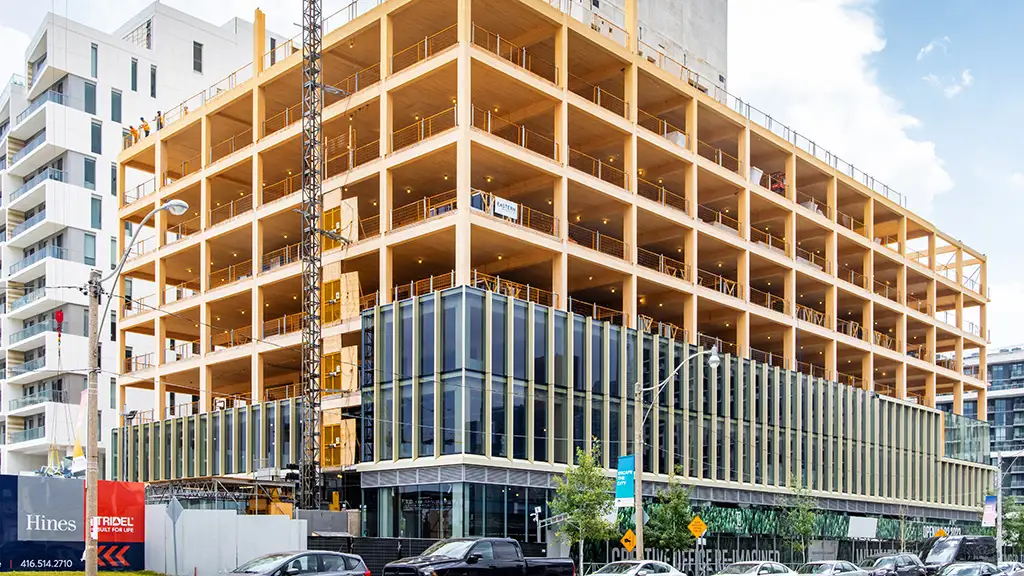
Legal experts discuss the complexities and risk management strategies involved in mass timber construction at a Sustainable Buildings Canada webinar.
Managing risk in mass timber construction presents unique challenges compared to traditional building methods, necessitating thorough early coordination and planning among all stakeholders involved. Catherine DiMarco, a partner and certified construction law specialist at Blaney McMurtry, emphasized the importance of identifying potential risks and assigning them appropriately to avoid disputes that could escalate to litigation or arbitration. This insight was shared during a recent webinar hosted by Sustainable Buildings Canada (SBC).One of the critical factors in planning mass timber projects is the timing of onsite construction. DiMarco noted that safeguarding the timber from water damage, adhering to fire codes, and meeting acoustical requirements are as crucial as designing the foundation and slab-on-grade, which are essential for the precise installation of anchors and fasteners. She pointed out that the relative novelty of mass timber technology increases the likelihood of misunderstandings regarding responsibilities, leading to situations where parties may inadvertently assume risks without realizing it.
In Ontario, a commonly utilized contract framework is the CCDC 2, a stipulated-price agreement between the project owner and the general contractor (GC). Under this model, the GC is responsible for subcontracting work to other contractors and possibly engaging suppliers. Additionally, there is often a professional services agreement in place between the owner and a consultant, typically an architect or engineer, which aligns with the stipulations of CCDC 2.
Another traditional approach, the CCDC 5B contract, classifies the construction manager as at risk, involving them in pre-construction services like budgeting, scheduling, and assessing the constructability of the project before they take on the general contractor's role during construction. However, DiMarco pointed out that these contracts are primarily designed for conventional construction projects where all activities occur on-site. Mass timber projects, conversely, entail significant off-site work, complicating the allocation of responsibilities for storing and maintaining the timber after it has been manufactured.
Determining who is accountable for the warehousing of mass timber, monitoring its moisture levels, and ensuring timely deliveries presents a host of challenges. DiMarco stressed that these risks need to be explicitly incorporated into the contract through supplementary conditions. She suggested that future iterations of CCDC contracts may need to be specifically tailored for mass timber projects to address these complexities.
Amelia Phillips Robbins, a senior associate in the construction law group at Blaney McMurtry, also presented at the SBC webinar, highlighting the Integrated Project Delivery (IPD) contracts (CCDC 30) which foster collaboration among all parties involved. In this arrangement, mistakes made by one party are typically mitigated through collective responsibility, thereby minimizing the risk of disputes. The use of Building Information Modeling (BIM) is prevalent within the integrated teams, as it aligns everyone towards common objectives. Robbins noted that early involvement of manufacturers and suppliers is crucial in this model, allowing them to contribute during the planning phase.
The CCDC 30 contracts also accommodate additional parties later in the project under a schedule C. Robbins explained that IPDs include a validation stage that yields a comprehensive report, aiding the owner and project team in deciding whether to proceed or terminate the contract. She stressed the significance of extensive pre-planning to ensure projects remain on schedule and within budget, which involves conducting early site assessments and securing necessary government approvals based on a realistic budget reflecting the design.
DiMarco warned that CCDC contracts can sometimes be mismatched for consultants in mass timber projects, as they are expected to perform regular job site visits rather than monitoring the manufacturing facility. This raises questions about billing practices and the consultant's role during the off-site manufacturing phase. She suggested that revising the language of the place-of-work clause in contracts may help clarify responsibilities for certifying values and processing payment applications for off-site manufacturing efforts.
In summary, the complexities of managing risks in mass timber projects require careful planning and clear contractual arrangements to avoid disputes and ensure project success. The insights shared during the SBC webinar underscore the need for evolving contractual frameworks that accommodate the unique challenges posed by mass timber construction.
🏷️
Integrated Project Delivery
CCDC contracts
construction management
risk management
construction planning
Mass Timber
fire safety
sustainable building
building codes
construction law
← Previous Post
Progress Update on CAMH's Waverley House Project as Construction Advances2 months ago
Next Article →
Cape Breton University Launches Innovative $59.8 Million Medical School to Address Doctor Shortage2 months ago