Deconstruction of Pattullo Bridge Underway as New stal̕əw̓asəm Bridge Opens
📅 4 months ago
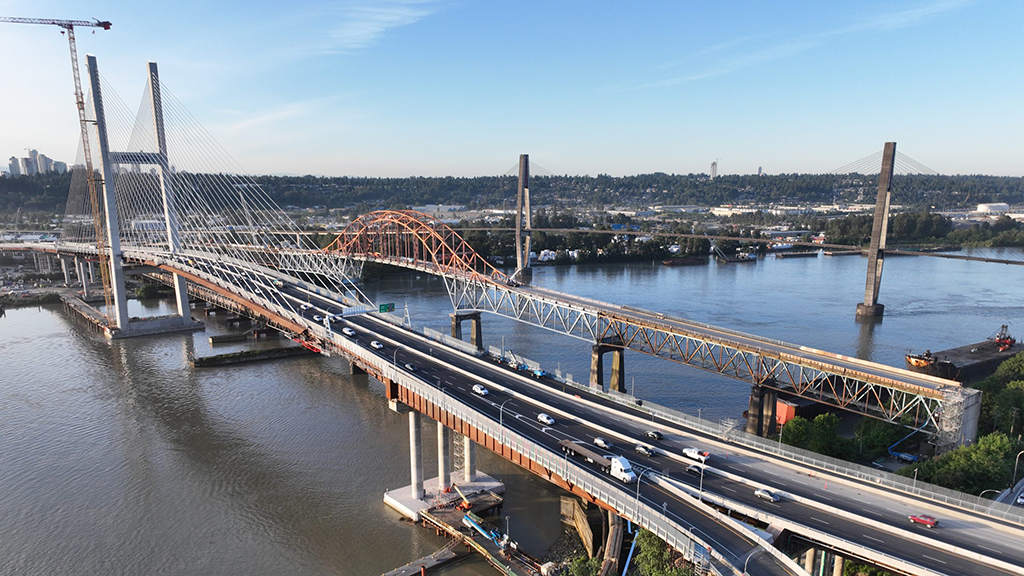
The deconstruction of the Pattullo Bridge has commenced following the completion of the new stal̕əw̓asəm Bridge, with a targeted completion date set for the end of 2027.
Commuters in the B.C. Lower Mainland can finally benefit from the new stal̕əw̓asəm (Riverview) Bridge, which officially opened in February after five years of construction. However, the project is not yet fully complete, as the deconstruction of the old Pattullo Bridge is still in progress. The Pattullo Bridge, which has served the community for nearly 90 years, has surpassed its intended design lifespan and is now in the process of being dismantled. The responsibility for this significant deconstruction effort falls to Fraser Crossing Partners, the government’s contractor for the $1.637-billion project. This joint venture comprises Aecon and Acciona, who are tasked with the design, construction, and partial financing of the new bridge.The B.C. Ministry of Transportation and Transit has recently outlined the challenges and timelines associated with the deconstruction, which is expected to take two years. Communications director Carlene Thistle-Walker emphasized the need for careful planning due to the proximity of critical infrastructure, such as a rail swing bridge located just 50 metres away and five active railway lines. The ministry has stated that collaboration with various stakeholders, including rail operators, utility providers, marine users, and local municipalities, is essential to maintain uninterrupted operations during the deconstruction process.
As of April 2026, construction of the Highway 17 off-ramp from the new stal̕əw̓asəm Bridge in Surrey is also underway. The ministry has confirmed that the targeted completion date for the deconstruction of the Pattullo Bridge by the end of 2027 remains achievable. The deconstruction will occur in three distinct phases: on-land, above-water, and below-water. Currently, work is focused on dismantling on-land structures in both New Westminster and Surrey, with the demolition of the north and south bridge approaches commencing from the bridge deck down to the foundations.
The deconstruction of the bridge over Columbia Street in New Westminster and above Highway 17 in Surrey has already reached completion. Thistle-Walker reported that crews are now working on deconstructing the south approach concrete spans. The deconstruction plan includes a detailed sequencing approach: temporary bracing and supports installation, sidewalk and handrail removal, concrete bridge deck removal through saw-cutting, and subsequent lifting by cranes or excavators. Additionally, steel spans will be removed in large sections, and components will either be reused or disposed of appropriately.
In terms of methodology, the concrete will be broken down using specialized attachments on long-reach excavators, which will load the debris into dump trucks for removal. The demolition process will utilize impact hammers to break the concrete apart, shears to cut rebar reinforcement, and pulverizers to reduce the concrete into smaller pieces. Similar techniques will be employed for the deconstruction of concrete piers located in the river, utilizing floating platforms and barges.
As of May, the removal of sidewalks on the bridge deck has commenced, and the removal of the bridge deck’s concrete panels is currently underway. Preparations for the removal of the main span, characterized by its distinctive orange arch, are also in progress, involving the installation of braces to support the structure during its lowering onto a barge.
To address environmental concerns, the ministry has implemented mitigation measures to control noise, dust, and prevent demolition materials from contaminating sensitive areas. The on-land piers will be cut down to ground level without further soil removal. The Pattullo Bridge, known for its unique steel arch engineering, presents certain complexities in the deconstruction process. According to Thistle-Walker, the concrete girders are cast around a central steel truss, necessitating the removal of the concrete before the truss itself can be dismantled.
In contrast, the new stal̕əw̓asəm Bridge features a single tower cable-stay design, with each cable containing up to 80 strands. The main span’s longest cable measures approximately 300 metres, and the entire bridge stretches 1,235 metres in length. Designed for improved traffic flow, the new bridge includes four wider traffic lanes along with a centre median and barrier-separated walking and cycling lanes. The community is encouraged to embrace the Indigenous name stal̕əw̓asəm, which translates to 'a space where you can view the river', as advocated by project proponents including the Kwantlen First Nation and Musqueam Indian Band.
🏷️
Transportation
British Columbia
Pattullo Bridge
deconstruction
Infrastructure
civil engineering
Environmental Mitigation
Indigenous Collaboration
stal̕əw̓asəm Bridge
Bridge Construction
← Previous Post
Firm Capital Property Trust Advances Acquisition of Manufactured Home Communities Following Competition Bureau Clearance4 months ago
Next Article →
George Greenwood Appointed CEO of CHBA BC, Aiming to Navigate Complex Homebuilding Challenges4 months ago