New High-Rise Mixed-Use Tower Proposed in Vancouver with Focus on Social Housing
📅 4 months ago
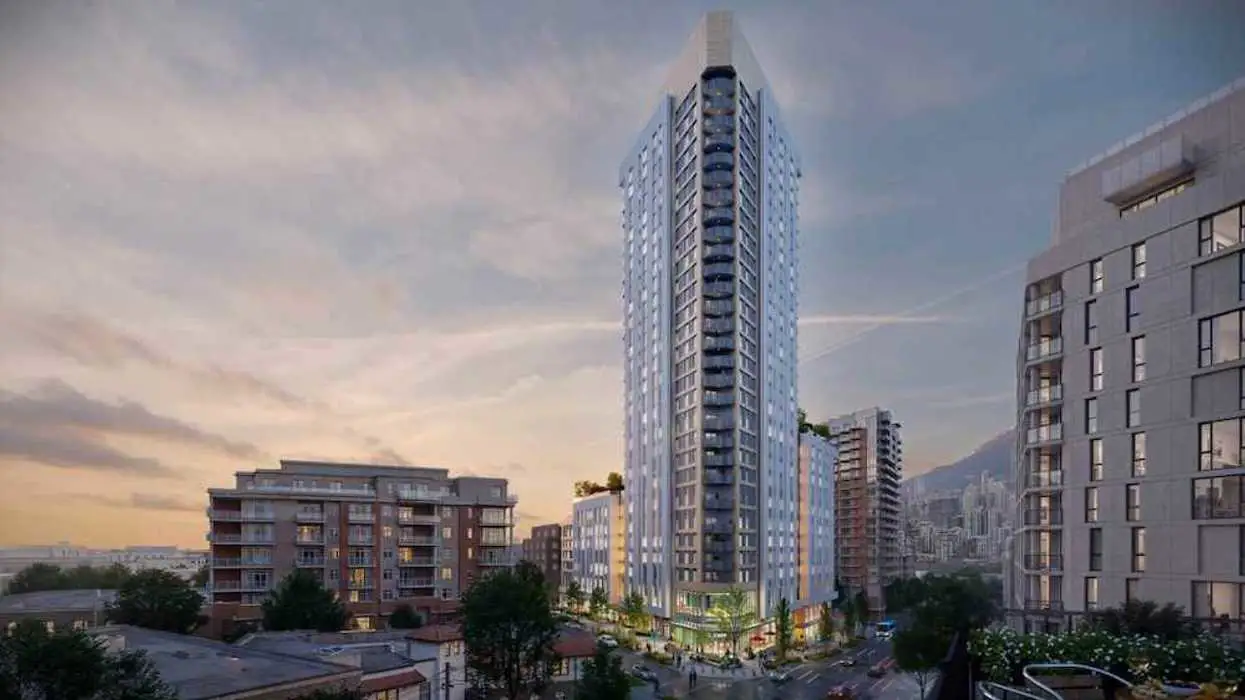
A rezoning application has been submitted for a high-rise mixed-use tower in Vancouver focused on social housing. The development aims to provide 364 social housing units along with community and health services.
A new rezoning application has been lodged for a high-rise mixed-use tower in Vancouver's Mount Pleasant neighbourhood, with the residential portion dedicated entirely to social housing. The site in question is located at 259-293 East 11th Avenue and 216 Kingsway, positioned on the western side of Sophia Street and falling within the Broadway Plan area. This site is distinctive as it encompasses multiple parcels: 259 E 11th Avenue (legally 251 E 11th Avenue), 283 E 11th Avenue, an unaddressed parcel, and 293 E 11th Avenue, along with 216 Kingsway, which is separated by a rear lane set for closure and acquisition. Currently, the Kingsway parcel functions as a surface parking lot, while the E 11th Avenue parcels host several low-rise office buildings, including Coast Mental Health's offices, which own these properties through the Coast Foundation Society established in 1974.According to BC Assessment, the values for the E 11th Avenue parcels are assessed at $5,440,000, $2,128,000, $1,236,400, and $5,892,000, while the Kingsway parcel is valued at $2,115,700, culminating in a total assessed value of $16,812,100 effective July 1, 2025. Coast Mental Health is advocating for the rezoning of this trapezoidal site from the C-3A (Commercial) District to CD-1 (Comprehensive Development). The proposed design includes a striking 29-storey mixed-use tower, reaching a maximum height of 334 feet and a density of 10.09 FSR.
The tower plans to incorporate 364 social housing units, featuring a diverse suite mix: 109 studio units, 157 one-bedroom units, 67 two-bedroom units, 27 three-bedroom units, and four four-bedroom units. The average sizes for these units will be 420 sq. ft, 520 sq. ft, 737 sq. ft, 924 sq. ft, and 1,278 sq. ft, respectively. Additionally, the residential section will comprise 17 assisted living units with an average size of 351 sq. ft.
In terms of non-residential space, the project will offer two levels that include 13,035 sq. ft of retail, an 8,581 sq. ft community health centre, an 8,518 sq. ft community hub, 11,133 sq. ft of office space that will serve as Coast Mental Health's headquarters, and 12,032 sq. ft designated for a recovery and support centre. Notably, while the City of Vancouver has removed minimum parking requirements, the proposal outlines provisions for 123 vehicle parking stalls and 666 bicycle parking stalls within a three-level underground parking structure.
Details concerning the rezoning application remain sparse; however, Vancouver's Cornerstore Planning Group has been engaged as a consultant for the project. Their website describes the initiative as an 'integrated mental-wellness campus.' According to Cornerstone, the study produced a model and program for a mental wellness campus that includes phased operations covering recovery, community, clinical, housing, research, commercial, and administrative components. The study also identified significant capital and operational risks with proposed mitigation strategies focusing on phased development, partnership funding, and appropriately sized functional programming.
The City of Vancouver is currently facilitating a Q&A period for the rezoning application, running from Wednesday, June 17 to Thursday, July 2. Coast Mental Health, founded in 1972, positions itself as a trusted non-profit that assists individuals dealing with mental illness to recover and flourish. The organization provides housing, supportive services, and employment opportunities, employing a client-centered, recovery-focused approach to ensure individuals navigate their own recovery journeys.
Coast Mental Health embarked on its first affordable rental housing project in 1974, a concept introduced by Jackie Hooper, a former psychiatric patient. This project was completed under her guidance and subsequently honored by renaming the building Hooper Apartments in 1997. This housing model has since become a cornerstone of Coast Mental Health’s services since its re-incorporation in 1974. Currently, the organization operates over two dozen housing sites throughout Metro Vancouver, encompassing various types of community homes, supportive housing, assisted living, and recovery facilities.
🏷️
Rezoning
mental health
Vancouver
Urban planning
mixed-use development
Affordable housing
community services
social housing
high-rise tower
Coast Mental Health
← Previous Post
Vancouver's Official Development Plan: A Blueprint for 17 Villages Over 30 Years4 months ago
Next Article →
Charges Filed Against Individuals and Companies in Hong Kong's Deadly Fire Incident4 months ago